Would John Stewart Do the News Again
T here was no one moment when Jon Stewart knew it was time for him to exit what he describes as "the almost perfect job in the earth"; no epiphany, no flashpoint. "Life," he says, in the lightly self-mocking tone he uses when talking about himself, "doesn't really work that way, with a finger pointing at you out of the sky, saying, 'Leave now!' That merely happens when y'all're fired, and trust me, I know about that."
Instead, he describes his decision to quit The Daily Testify, the American satirical news programme he has hosted for 16 years, as something closer to the end of a long-term relationship. "It's not like I thought the show wasn't working whatsoever more, or that I didn't know how to do it. Information technology was more, 'Yup, it'southward working. But I'chiliad not getting the same satisfaction.'" He slaps his easily on his desk, conclusively.
"These things are cyclical. You have moments of dissatisfaction, and then you come out of it and information technology'southward OK. Simply the cycles become longer and perhaps more entrenched, and that's when you realise, 'OK, I'one thousand on the back side of it now.'"
Stewart and I speak twice in the space of a few months. The get-go time last Oct, when he flew from New York to London with his family for the premiere of his directorial debut at the London Film Festival. Rosewater is an engrossing and pacy film that tells the truthful story of Iranian-born journalist Maziar Bahari, who was arrested and tortured in Iran in 2009, after sending footage of street riots to the BBC.
The second fourth dimension, we speak shortly after Stewart announces his retirement from The Daily Show. He is in his office in New York, preparing to shoot a Friday-night episode, and the difference in his mood is hitting. His voice is well-nigh an octave lower, and he sounds weary, weighed downwardly.
But talking well-nigh his flick in London, he is animated to the point of hyperactivity, gleefully pointing out the pretentious decor in the hotel room where we meet ("A photo of a submissive woman with a cigar in her mouth! Just what every room needs!"). He notes, in a tone that is both sincere and satirical, and that will be familiar to fans of The Daily Show, the lavishness of the food: "My compliments to the prop main, because that really is a beautiful tomato and mozzarella salad," he intones solemnly to a bemused waiter.
Like every TV celebrity, in person, Stewart is both improve-looking than you await and smaller, with his long trunk making upwardly well-nigh of his 5ft 7in, giving the illusion of elevation from behind his studio desk-bound. He is dressed casually, and after years of watching him on Idiot box wearing a conform, seeing him in a T-shirt and casual trousers feels nearly like catching my male parent one-half-undressed.
At 52, Stewart has the bouncy energy of a homo one-half his historic period and, dissimilar most in the public eye, has an aversion to compliments. If I tell him I liked something about the flick, he will immediately deflect the compliment and insist it was all down to Bahari, or the movie'southward star Gael García Bernal, or the coiffure. For all the claims of his detractors that Stewart is the image of E Coast elitism, there is more self-deprecating New Jersey grit hither than arrogant Manhattan elan.
Much every bit he might wince to hear it, for the past xvi years Stewart has occupied a place in America's cultural and political life far greater than the small audience of his cable show would suggest. The Daily Show's uncomplicated format consists of a mix of reports from roving reporters (who accept included Steve Carell, Stephen Colbert and John Oliver), monologues delivered by Stewart and an end-of-show interview. Over time, Stewart has evolved from a satirist to a broadcaster celebrated as the vocalisation of US liberalism, the i who will requite the definitive progressive have on a story.
His moving monologue after the Charlie Hebdo killings in Jan was widely shared; his frequent on-air support of Democrat senator Elizabeth Warren helped her evolve in the eyes of the public from Harvard professor to dream 2016 presidential candidate – especially among those who observe Hillary Clinton too centrist and hawkish. Stewart'southward energetic candidature on behalf of the 9/xi start responders (the emergency services who were offset on the scene, many of whom afterwards suffered debilitating illnesses), prompted the New York Times to compare him to Walter Cronkite and Edward R Murrow, the most revered newscasters in American history. It is a delicious irony that in the globe of American TV news, one populated past raging egotists and cocky-aggrandisers, the person who is generally cited as the most influential is Stewart – a human so disinterested in his own celebrity, he often didn't bother to collect his 18 Emmys, preferring to stay at home with his family unit.
When George Bush left office in 2008, some worried that Stewart would run out of material. This proved as shortsighted equally the promise that Obama would be America's grand salvation. Stewart, who describes himself as "a leftist", has e'er hammered the Democrats with the vigour of a disappointed supporter, and subjected Obama to ane of his most dissentious interviews during his start term: the president admitted that his 2008 slogan probably should accept been "Yep We Can, Merely..." At the fourth dimension, Stewart laughed, just today he admits with a shrug, "It was heartbreaking. It'southward mostly heartbreaking – that'southward what the gig is."
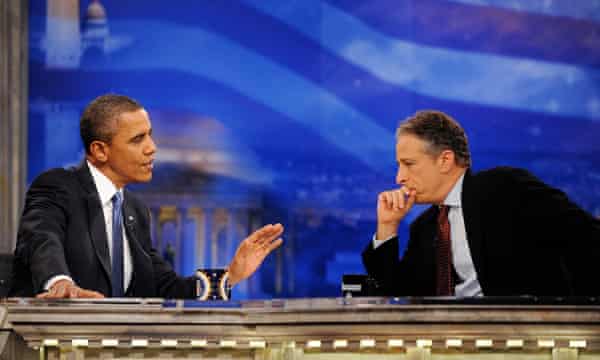
His seemingly effortless interview with Tony Blair in 2008 cut through Blair'south crusader mentality in a mere half-dozen minutes, every bit Stewart calmly rejected Blair's theory that any kind of military action can go on the due west safe. As Blair stammered, huffed and shifted in his seat, Stewart concluded that: "19 people flew into the towers. It seems difficult for me to imagine that we could go to state of war enough, to make the globe condom enough, that 19 people wouldn't want to do harm to us. And so it seems like we take to rethink a strategy that is less war machine-based." This was Stewart at his best; it's too fair to say that some of the interviews, generally those with actors and authors, seem like mere puffery, a point with which Stewart agrees (he embraces criticism every bit eagerly equally he deflects compliments).
How often does he really connect with his interviewees? "Accept you seen the show? Mostly, I'm not fifty-fifty listening. But I can bullshit anyone for six minutes."
When we run across in October, I enquire if he is thinking of leaving The Daily Prove because he seems increasingly, well, bored, making frequent references to the fact he'southward been doing the show "for 75, fourscore, 1,000 years".
He bats away my question with a joke: "Are you offering me a job?"
Well, I might exist able to go you Guardian work experience.
"Aww, I'm too shitty a writer for that."
Simply he doesn't reject the thought entirely (of leaving The Daily Show, that is. I remember The Guardian will have to expect): "[If I left the show,] I would exercise what I'm doing. Whether it's standup, the prove, books or films, I consider all this simply different vehicles to proceed a chat well-nigh what it ways to exist a democratic nation, and to have it written into the constitution that all men are created equal – but to live with that for 100 years with slaves. How do those contradictions play themselves out? And how do we honestly assess our failings and move frontward with integrity?"
When I grab up with him again, I ask if he knew he'd exist leaving when we had that conversation.
"No, no – merely some of it had been in the back of my head for quite some time. But you don't desire to make any kind of decision when yous're in the crucible of the procedure, just like you don't decide whether you're going to continue to run marathons in mile 24," he says.
He switches to a chewy exaggeration of his native Noo Joi-zy accent, deflating his seriousness with a one-act vocalism. "You lot expect until you're done, you lot accept a nice cup o' h2o, you put the coating on, y'all sit and then you make up one's mind."
I had assumed that, as well every bit the metaphorical loving cup o' h2o, he had decided to quit considering he had so much fun making Rosewater. Only Stewart says non.
"Honestly, it was a combination of the limitations of my brain and a format that is geared towards following an increasingly redundant process, which is our political process. I was only thinking, 'Are there other ways to pare this cat?' And, beyond that, it would be prissy to be home when my fiddling elves get home from school, occasionally."
He has a 10-twelvemonth-quondam son, Nathan, and a 9-twelvemonth-erstwhile daughter, Maggie; Stewart and his wife, Tracey, take been married for about as long every bit he'southward been doing the evidence, later on Stewart proposed to her via a crossword puzzle.
If anything, it was the prospect of the upcoming US election that pushed him to leave the bear witness. "I'd covered an election four times, and it didn't announced that at that place was going to be anything wildly different about this 1," he says.
Ah, just who could accept predictable the excitement over Hillary Clinton's deleted emails?
"Anyone could, because that story is absolutely everything that information technology'due south supposed to be about," he says, with a groan; equally a revelation, it managed to be at once depressing and completely unsurprising. "I also felt that, for the bear witness, you don't want to exit when the cupboard's bare. So I retrieve information technology's a better introduction when you have something providing you lot with assisted fuel, like a presidential entrada. But actually, the value of this show is and so much deeper than my contribution," he says.
Stewart likes to credit "the team", only given that he has always been securely involved in the script (unusually for a host), writing and rewriting drafts right up to the terminal minute, the evidence will be a pretty different animal without him. He has described his successor, the South African comedian Trevor Noah, as "incredibly thoughtful, considerate and funny", and dedicated him when information technology was discovered, to widespread fury, that Noah had in the past tweeted offensive jokes about Jews, overweight women and transgender people.
The furore over Noah's tweets reflects only how high Stewart has fix the bar. At that place was such an outpouring of grief when he announced he was stepping downward, that he mused on air the following day, "Did I die?" Even the normally dispassionate New Yorker magazine claimed, nether the headline Jon Stewart, We Demand You In 2016, "the last hope for bringing some rationality to the 2016 Presidential field died". Not since Oprah Winfrey announced her retirement from network television set has a Us TV host'south departure received such international coverage, just Stewart bridles when I make the Winfrey comparison: "If Oprah tin get out and the globe however spins, I honestly think it will survive me."
And information technology should exist noted that not everyone was distraught. Trick News, displaying its mastery of making color-based accusations about the kettle from its pot-based position, reported that Stewart was "not a force for expert" and that his sustained criticisms of the right "had no foothold in the facts". The Daily Show duly responded with a Vine of Fox News' best factual distortions.
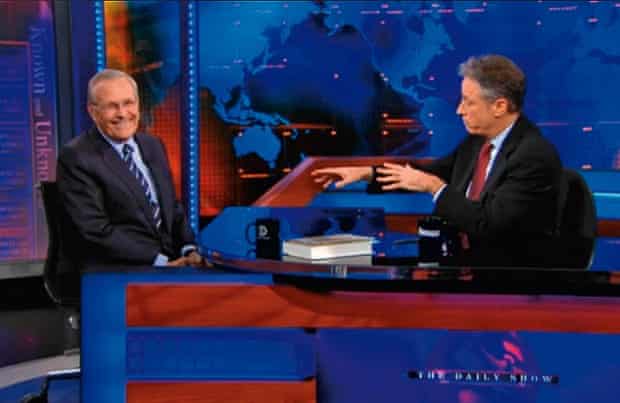
Does he have any regrets? Stewart recounts i large thwarting – an anodyne interview with Donald Rumsfeld in 2011 that failed to claim the former secretary of defence'south scalp. "He merely went into the general gobbledegook." Stewart puts on a pretty proficient imitation of Rumsfeld: "'Mnah mnah mnah, well, you have to think, it was ix/11 mnah mnah.' I should take pushed, just he's very expert at deflecting." He looks genuinely crushed for a moment, then rallies: "That interview with Rumsfeld went shitty, simply it's still just an interview. He's the one who has to live with the repercussions of what he really did, and then there's nothing that could happen on my show that carries that same level of regret."
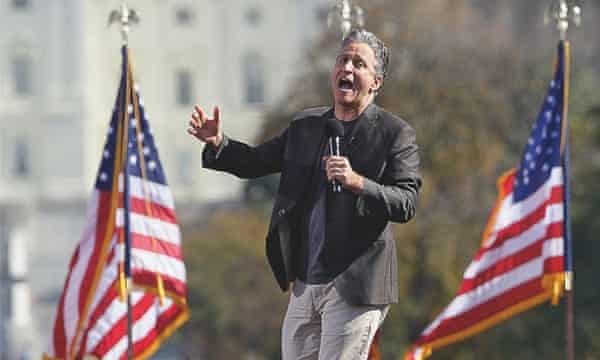
In 2010, Stewart hosted a Rally To Restore Sanity in Washington DC, attracting 215,000 people, who cheered him on as he berated the media, or "the country's 24-hour pol–pundit-perpetual-panic-'conflictinator'." I covered the rally for the Guardian and, every bit enjoyable as Stewart was, he didn't look peculiarly comfortable up on the stage, ginning up the people. He agrees that entering politics "is not my bag": he'd rather brand sense of the mess than get into it himself.
He tin can exist brutal nearly the leftwing media, too (CNN has been a frequent target, for being mediocre and too attached to pointless computer graphics). MSNBC, the liberal 24-hr news network, is, Stewart says, "better" than Flim-flam News, "because it'southward not steeped in distortion and ignorance as a virtue. But they're both relentless and congenital for ix/11. So, in the absence of such a catastrophic consequence, they take the zippo and amplify it and arrive craziness."
My biggest objection to Fox News, I say, is not the scaremongering, information technology's the way it's reshaped the Republican party. It volition misrepresent social and economic bug, and promote the more extreme elements of the political party, politicians such every bit Sarah Palin and Mike Huckabee, in a way that is hugely detrimental to American politics. (For the record, Rupert Murdoch disagrees, and terminal year claimed that Play tricks News "absolutely saved" the Republican political party.) "Watching these channels all day is incredibly depressing," says Stewart. "I live in a abiding country of depression. I think of u.s.a. as turd miners. I put on my helmet, I get and mine turds, hopefully I don't go turd lung disease."
Now that he is leaving The Daily Show, is there whatsoever circumstance in which he would lookout man Fox News once again? He takes a few seconds to ponder the question. "Umm… All correct, allow'south say that it's a nuclear wintertime, and I have been wandering, and in that location appears to exist a flickering light through what appears to be a radioactive cloud and I call back that light might be a food source that could help my family unit. I might glance at it for a moment until I realise, that's Play tricks News, and and then I shut it off. That's the circumstance."
About a calendar week before nosotros met final year, Piers Morgan, who had simply lost his nightly interview show on CNN, loudly blamed news anchor Anderson Cooper, whose show ran earlier Morgan'south, for his low ratings. Stewart shakes his head in wonder at this claim. "That guy may be the biggest – I mean, isn't there a room underneath the Tower of London where y'all can but lock him upwards? He's upset because he got shit-kicked. Who'southward he going to blame – himself? That would mean self-reflection, of which he is incapable."
We talk a little about what were then mere rumours that telephone hacking had taken place at the Daily Mirror while Morgan was its editor. (Information technology has since been alleged in the loftier court that hacking was carried out "on an industrial scale" during Morgan's tenure.) "Right, that is a guy who is a bad person, which is fine – bad people are everywhere," Stewart shrugs. "Only where does something like that come from? Is there a secret fountain of doucheyness somewhere?"
Since he asked, I tell Stewart how Morgan and Simon Cowell became friends in the 1990s, later Morgan helped promote the Cowell-produced singing duo Robson & Jerome in the Sun. When Morgan was fired from the Mirror, Cowell returned the favour by casting him as a judge on his talent shows and, in plow, introducing him to an American TV audition.
Stewart's confront is frozen into a parody of Munch's The Scream, and he is briefly speechless. "Well," he eventually says, "all I tin say is, 'Damn you lot Robson and whatever the other guy's name was.' Just awful."
J on Stuart Leibowitz was born in New York and raised in New Bailiwick of jersey, the son of a teacher and a professor of physics. He grew up in the shadow of the Vietnam war and Watergate, events that left him, he has said in the past, "with a healthy scepticism towards official reports". He jokingly recalls the time his older brother fired him from his outset chore at Woolworths as one of the defining, "scarring events" of his youth. But his parents' divorce when he was 11 was clearly more so, prompting him to drop his surname and eventually legally modify it to Stewart. He has described his human relationship with his father as still "complicated". "There was a idea of using my female parent'due south maiden name, just I idea that would be only likewise big a fuck you to my dad," he says. "Did I have some problems with my father? Yeah. Notwithstanding people always view it [changing his surname] through the prism of ethnic identity."

And so information technology was a family thing as opposed to a Jewish thing? "Right. So whenever I criticise Israel's actions it's [he puts on a Yiddishy accent] 'He'south changed his name! He'due south non a Jew! He hates himself!' And I'm like, 'I detest myself for a lot of reasons, just not because I'm Jewish.'"
After college, Stewart performed on the standup circuit in New York, landing his own talkshow on MTV in the 1990s. In 1999, he took over the then little-loved Daily Show on Comedy Fundamental, turning it from hit-and-miss satire to the news- and politics-focused programme information technology is today. Coming to it at 38, he says, the job was so ideal, "I couldn't have created one ameliorate".
Since Stewart announced his departure, much has been written virtually him existence the most trusted news source for immature Americans. Stewart kiboshes this as "conventional wisdom. In the ocean of data that surrounds people of that generation, I'd be truly surprised if their only news comes four days of the week, for a few minutes a dark." He laughs when I describe him as a celebrity ("I'k not Madonna!" he hoots, raising an eyebrow). The but brake fame has put on his freedom, he says, is "I don't hang out on the Upper West Side during Sukkot". Isn't he beingness a fleck faux modest, I ask, especially when he insists that what he does is comedy and not news? That comes with a sure profile. He thinks about this for a few seconds. "It'south not that I… I mean, it'due south satire, so it's an expression of real feelings. Then I don't mean that in the sense of, 'I don't mean this.' What I mean is, the tools of satire should non be confused with the tools of news. We utilise hyperbole, but the underlying sentiment has to feel ethically, intentionally right, otherwise nosotros wouldn't do it."
If Stewart always needed proof that his prove has an impact, he got it in pretty much the worst way possible in October 2009, when he discovered that Iranian guards had arrested Maziar Bahari presently later on he gave an interview to The Daily Show in Islamic republic of iran. "And non just Maziar, merely everybody we interviewed at that place had been arrested. So, beingness American, we thought, 'This must be all nearly us!'" he says.
The Daily Show spoke to the prisoners' families and asked what they could do to assist, and the response was unanimous: go on talking about the arrests on the testify. So Stewart did. Ironically, the reason The Daily Show had gone to Islamic republic of iran in the first place was to undermine Bush's clarification of the region as "the centrality of evil": Stewart wanted America to run across a country populated by "people with families who are wonderful". And although they institute those, the project turned out to be, he says, "a very, uh, sobering experience".
When Bahari was released after 118 days, Stewart learned that his Iranian guards had cited the (completely benign) Daily Bear witness interview he gave equally a justification to torture and imprison him. "And that," he says, with some understatement, "just stunned me."
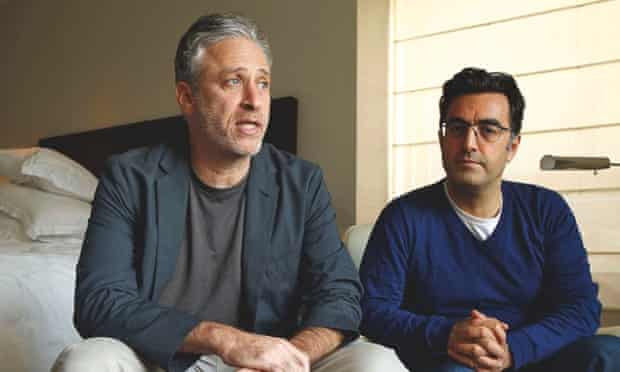
He and Bahari became friends; when Bahari was in the United states, they would meet for breakfast in Manhattan, near Stewart's Tribeca domicile. Bahari said he hoped someone would make a movie of his book about his feel, Then They Came For Me. Stewart helped Bahari contact screenwriters, only to observe that most were already busy, and he started to get, he says, "impatient with the process". Then, over oatmeal in a coffee shop, he and Bahari decided Stewart would write and direct the moving-picture show himself.
Rosewater focuses primarily on the human relationship between Bahari (Gael García Bernal) and ane particular jailer, played by Kim Bodnia (Martin in Scandinavian TV thriller The Bridge). The film wears its liberal heart on its sleeve, only reins in the tub-thumping for the sake of the story. Experts in Iranian relations will no doubtfulness find the depiction of the regime a little simplistic, and Stewart, characteristically, agrees.
"Look, it's a film about Islamic republic of iran made by a New York Jew – it'south going to be reductive for those who are from the region. Only hopefully, for an audience that is more western and more than accustomed to films like Not Without My Daughter, this volition announced to be a relatively nuanced portrayal. I got a whole pantheon of Sally Field references in hither," he grins, tapping his caput, a reference to the hysterically anti-Iranian 1991 moving picture.
A more obvious criticism is the lack of Iranian actors: Kim Bodnia, every bit Rosewater, is Danish and Bernal is Mexican. Stewart, again, concedes the point. "If I was Iranian, I'd probably look at [Bernal] and exist like, 'Really? Those Rs? Come on, man.' But Maziar was our touchstone, and if he wasn't bothered by information technology, I wasn't bothered by information technology. My original vision was, 'Maziar, nosotros're going to do this in Persian and use real prisoners and it'southward going to be only Iranians!' And he was like, 'Don't you want people to see information technology?'"
He did, but ultimately not that many people did, at least in the US. The film got decent reviews, just made only $3m – it turns out not that many Americans desire to come across a picture nigh an Iranian prisoner. For once, perhaps, Stewart was just that picayune bit too progressive, something he has joked well-nigh on The Daily Show, mock weeping.
How disappointed was he? "Oh, sure, I would accept liked more people to take seen it. But it'due south a ridiculous affair to say. We got to prepare this incredible meal and then at the very end say, 'Aww, I wish more people came.' I don't actually experience that fashion. I ever knew the movie wasn't The Hunger Games. But I hope it finds a petty foothold in the Britain."
For the next few months, Stewart will focus on The Daily Show, handing over to Trevor Noah later this year and trying to convince viewers that it volition be only fine without him. He has, he says, "a couple of other projects on the burner" – he would like to make more films – and it's impossible to imagine him in fallow retirement. But information technology won't be quite the same for us fans, getting to watch him every night, having him translate the day'due south news for us. Stewart would scoff, just, for liberals who care almost American politics, his departure from The Daily Show marks the end of an era.
"Honestly," he says, "the state volition survive." And he's right, information technology will. Only even as he says information technology, it sounds, somewhat heartbreakingly, as if he's already out that door.
Source: https://www.theguardian.com/media/2015/apr/18/jon-stewart-why-i-quit-the-daily-show

Posting Komentar untuk "Would John Stewart Do the News Again"